


Annual Booklist 2023 : Dr Michael Taylor
Michael Taylor is an independent scholar and an experienced museum professional now working freelance. His first degree, in geology, was awarded by the University of Wales in 1974, followed by a MA in British First World War Studies from the University of Birmingham in 2007 and a PhD from the same institution in 2017. He is a member of the British Commission for Military History, the Society for Army Historical Research and the Douglas Haig Fellowship, and is a Fellow of the Museums Association. He has lived near Perth, Scotland for many years and was a founder member and current Chair of the Tayside Branch, Western Front Association. His recent book, entitled No Bad Soldiers: 119 Infantry Brigade and Brigadier-General Frank Percy Crozier in the Great War, was shortlisted for the 2022 SAHR First Book Prize.
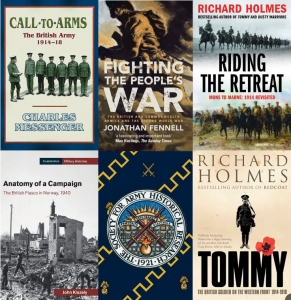
As a historian of the First World War, I have naturally gravitated to that subject to provide the majority of my book recommendations. However, the Second World War provides me with an occasional welcome 'escape' from the First and I was mightily impressed by the two Second World War titles I have chosen. My first two books are both by well-respected authors who are sadly no longer with us and who are fondly remembered by many, including myself. Both books provide a sound foundation for readers - and both could provide a foundation for a small house as they are substantial volumes! Both remain in print and there are paperback editions that make them (slightly) more portable.
Tommy: The British Soldier on the Western Front, 1914-1918 by Richard Holmes (Harper Collins, 2004)
This book is an absolute classic. Holmes has left us a study based on the personal experiences of ‘Tommy’, whether officer or other rank, building a picture of First World War service and experience packed with wonderful detail such as “In 1917 the price of a Christmas turkey, at 3s 2d a pound, cost 30 shillings, arguably better value than an up-market Parisienne lady of the night who charged a subaltern £8 for the pleasure of her company”. Holmes views his subject with affection, and it shows. His style is fluid and his tone measured throughout the 630-odd pages of text. Soundly researched, the endnotes and references take up 52 pages. If you’ve not read it, you will not be disappointed.
Call to Arms: The British Army, 1914-18 by Charles Messenger (Weidenfeld & Nicolson, 2005)
My second classic is this work by the late Charles Messenger, published just a year after Holmes’ Tommy. Messenger’s style is drier. He focusses less on the individual and, as indicated by the subtitle, more on the institution of the British army itself. He writes that “the main theme of the book is manpower … the army’s greatest struggle during 1914-18 was obtaining and maintaining the necessary strength to meet increasing commitments”. The issues are examined in the context of the Regular, Territorial, volunteer and conscript armies of the Great War with much useful detail on rules, regulations and guidance along the way. Although very similar in size to Tommy, the book is 150 pages shorter, partly accounted for by the smaller typeface for endnotes and references. It is useful both for background and as a 'go-to' reference work.
Fighting the Peoples’s War: The British and Commonwealth Armies and the Second World War by Jonathan Fennell (Cambridge University Press, 2019)
This is one of the most original scholarly works of recent years and another brick of a book at 932 pages. The Second World War is not my field, but I found myself completely engrossed by the wealth of information and detail. Choosing to look at the British and Commonwealth Armies in their entirety was a masterstroke that opened new arguments and new sources (and gave the author a huge task). The author writes that “the book investigates both the material culture and history of great armies in a world war and also the political, social, and economic factors that influenced their behaviour and experience”. His evidence, most of it new, is marshalled and analysed in support of the investigation. Fascinating in every respect. Heartily recommended as a refreshing new view of the army – just don’t try to read it in one go. It took me several weeks digesting a bite-sized piece before moving on to the next.
I was asked to suggest a book that has not been written yet. I wonder if someone could emulate Fennell's approach for the British (and Dominion?) forces in the First World War. I’m sure that many have had the same thought but are there sufficient sources to support the endeavour?
Anatomy of a Campaign: The British Fiasco in Norway, 1940 by John Kiszely (Cambridge University Press, 2017)
My fourth choice also examines an aspect of the Second World War in great detail. In this instance the 1940 Norway campaign, Britain’s first land campaign of the war, which came massively unstuck. John Kiszely examines every aspect of the campaign from inception and planning to execution and shows how poor decision making at every level resulted in fiasco. I was thoroughly immersed in the detail and actually read the book while cruising the Norwegian fjords – here is one book at least that can be digested on holiday.
Riding the Retreat: Mons to the Marne – 1914 Revisited by Richard Holmes (Jonathan Cape, 1995)
For my final choice I return to the battlefields of the First World War and a second book by Richard Holmes. An easy read, it is part military history and part travelogue. It was also a turning point for the author who, in a new preface to the 2007 paperback edition, acknowledged its role in formulating his views of the importance of walking (or in this case riding) the ground and of the experience of the individual soldier. The book also served as a springboard for the subsequent historical travels on which Holmes's career as an author and presenter was based. Holmes describes his adventures during his ride along the route of the British retreat from Mons like a true raconteur, but this book is not mere anecdote. There is much good military history woven through the story and at critical points forming the main narrative. A good read and easily pocketed (in paperback).