


Annual Booklist 2023 : Dr Nicole Hartwell
Dr Nicole M. Hartwell is a National Army Museum research fellow at Selwyn College, University of Cambridge. Her research focuses on the history of collecting and collections, military memorialisation and representations of warfare and imperial scenes in British art. She obtained her DPhil in Modern British and Imperial History from the University of Oxford (Lincoln College) and is currently writing her first book.
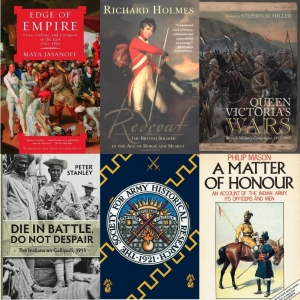
My first recommendation is of a book I credit with inspiring me to embark upon a degree specialising in the history of warfare during my undergraduate studies in Australia. I was a regular visitor to Elizabeth’s Bookshop in Fremantle, and one day saw a weighty hardcover on the shelf, signed by the author Richard Holmes, titled Redcoat: The British Soldier in the Age of Horse and Musket (2001). The ability of Holmes to write in such a lyrical fashion captivated my attention. In his trilogy, Redcoat, Tommy, and Sahib, he moved beyond documenting the history of the army to narrating the experiences of the soldier. Holmes writes of battle in such a way that you are drawn into the midst of the fighting, exploring familiar territories of traditional military history such as technology and tactics as well as the social life of men on campaign.
As a specialist in colonial military history of the late 18th-19th centuries my second recommendation is Philip Mason’s A Matter of Honour: An Account of the Indian Army, its Officers and Men (1974). Mason’s writing style is quite like that of Holmes', although the former attempts the challenging task of covering over 200 years of history and the experiences of men who served in all three presidency armies of the British East India Company and the re-organised British Indian Army in only one volume. Mason asks perennial questions that still bear further thought and investigation: What motivated men in the presidency armies to fight? How were cultural barriers overcome? What aspects contributed to the fact that so many campaigns fought by British-Indian forces were won? How were grievances voiced, addressed, challenged and disciplined?
Following Mason’s magisterial study, several works have emerged with a greater focus upon addressing the personal experiences of Indian men who served in the British Indian Army, with one of the more recent standouts being Peter Stanley’s Die in Battle, Do not Despair: The Indians on Gallipoli, 1915 (2021). Taking a campaign so intertwined with the formation of Australian identity and the ANZAC legend, Stanley foregrounds and recaptures the experiences of Indian men who lived, fought and died during this fateful theatre of battle during the First World War. He utilises a wide range of source material, including artistic sketches and incredibly rare photographs which have been unearthed through extensive archive research he has undertaken across the world.
I was pleased to see the recent release of Stephen M. Miller’s edited volume Queen Victoria’s Wars: British Military Campaigns, 1857-1902 (2021), as while several excellent surveys of colonial military campaigns have been published in the past, this has been a neglected field of late. Drawing upon a wide range of case studies, from the Indian Mutiny/Rebellion to campaigns in present-day Ethiopia, Afghanistan, and Africa, the chapters embed each conflict within wider geo-political and strategic contexts and engage with various themes, including military technologies, tactics and battle aims, tracing each war from outbreak to aftermath. A perfect compendium to dip in and out of, it traverses quite a wide geographical and temporal scope.
The history of collecting and collections is a particular research interest of mine, and while not strictly a military history book, Maya Jasanoff’s Edge of Empire: Lives, Culture and Conquest in the East, 1750-1850 (2005) presents a fascinating and compelling narrative of imperial conquest. Jasanoff employs the act of ‘collecting’ as a metaphor for the manner in which the British Empire in particular was ‘pieced together… shaped by a range of circumstances, accidents, and intentions’. The book interweaves the lives of several idiosyncratic characters who self-fashioned their own identities through the act of collecting in South Asia and Egypt. Key colonial battles are interwoven within her narrative, including the Fourth Anglo-Mysore War, one of several campaigns partly driven by British and French rivalries over control of the Indian subcontinent. Objects themselves act as significant touchstones in the book, and while this is a history of elites and their actions, it has inspired several works which have further investigated the cultural history of empire and the history of collections.
As for future publications, I would love to see military historians engage more with material culture. The National Army Museum, not to mention regimental, corps and service museums across Britain, hold fascinating yet understudied collections which have the potential to enrich existing histories and articulate under-represented perspectives of the experience of warfare in the colonial period. My own forthcoming book, which embeds operational and cultural military history with provenance research and artefact analysis, will hopefully inspire other historians to see the value of such an inter-disciplinary approach.