


Annual Booklist 2023 : Dr Luke Reynolds
Dr Luke Reynolds, FRHistS, is an Assistant Professor in Residence at the University of Connecticut, Stamford Campus. His recent book, Who Owned Waterloo? Battle, Memory, & Myth in British History, 1815-1852 (Oxford University Press, 2022), was highly commended in the Templer Best First Book competition and won the Society for Military History 2023 Distinguished Book Award in the First Book Category.
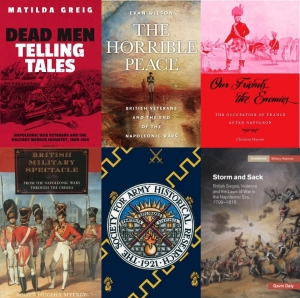
Evan Wilson, The Horrible Peace: British Veterans and the End of the Napoleonic Wars (University of Massachusetts Press, 2023)
The allied victory over Napoleon at the Battle of Waterloo and the subsequent surrender of France marks, in the traditional narrative of British history, the beginning of the Pax Britannica – a century-long global British hegemony that would last until the First World War. Evan Wilson’s The Horrible Peace complicates this, drilling through the propaganda to expose the economic hardship and political turmoil underneath. Charting the demobilization of the British forces that fought the Napoleonic Wars and the tribulations of those who stayed in uniform, Wilson paints two pictures: one of a Britain rife with unemployment, threatened by volcanic crop failures, and facing calls for reform that those in power felt would inevitably lead to a guillotine in St. James’s Square, and the other of a cash-strapped empire trying desperately to appear invincible even as it cut costs and corners. A must for anyone interested in demobilization or the rough start of Britain’s imperial century.
Gavin Daly, Storm and Sack: British Sieges, Violence and the Laws of War in the Napoleonic Era, 1799-1815 (Cambridge University Press, 2022)
A very welcome new history of British siege warfare in the Napoleonic era, Daly’s Storm and Sack examines every aspect of what was simultaneously the most scientific and brutal form of war. Rather than limiting himself to operational matters in the Peninsula, Daly expands his scope to examine legal, social, and cultural matters, along with operational, on multiple continents. The result is a work that not only puts a reader in the breaches, but also shines new light on the British culture of war in general, how it changed depending on who they were fighting, and how the individual soldiers reacted to and processed the violence they were both experiencing and meting out.
Matilda Greig, Dead Men Telling Tales: Napoleonic War Veterans and the Military Memoir Industry, 1808-1914 (Oxford University Press, 2021)
An important contribution to the scholarship examining memoirs as items of cultural and material history in their own right instead of merely as sources, Greig’s work provides a fascinating history of the “military memoir industry” in Britain, France, Portugal, and Spain. Of particular interest to SAHR members are her insights into the trope of the accidental author (the bluff, no-nonsense old soldier), and her deep readings of sources that demonstrate the problems with using memoirs written for publication as unbiased “authentic” sources.
Christine Haynes, Our Friends the Enemies: The Occupation of France after Napoleon (Harvard University Press, 2018)
Much has been written about the long peace the Concert of Europe fashioned in the aftermath of the Napoleonic Wars, but there has been a relative dearth of scholarship on the multi-national army of occupation that was stationed in France from 1815-1818. Haynes fills that gap with Our Friends the Enemies, which examines the occupation from military, economic, political, social, and cultural points of view. Incorporating perspectives and sources from both the occupiers and the occupied, Haynes details the everyday life and broad over-arching purpose of what was arguably not only the first modern occupation, but also the most successful reconstruction of a defeated nation until the efforts undertaken in Germany and Japan following the Second World War.
Scott Hughes Myerly, British Military Spectacle from the Napoleonic Wars Through the Crimea (Harvard University Press, 1996)
While some recent work (including my own) has pushed back against some of Myerly’s more sweeping social claims, British Military Spectacle remains a must-read for anyone interested in the confluence of display and power. Examining the British Army at the height of their scarlet pomp, Myerly demonstrates how uniforms and display were crucial to not only the army’s self-image and survival but also to how they interacted with and were viewed by civilian society. (This work makes for a fascinating double bill alongside Edward Coss’ All for the King’s Shilling, which appeared on the 2021-2022 booklist.)
As for my suggestion for a book that doesn’t yet exist but should, we need a new history of the Purchase System and its abolition by the Cardwell Reforms. Anthony P. Bruce’s sadly out of print The Purchase System in the British Army, 1660-1871 (Royal Historical Society, 1980) has done sterling service, but so much new work has been done on the political, economic, social, and cultural relationship between Britain and the British Army in the four-plus decades since its publication, not to mention the discovery and digitization of new sources, that a new book would provide crucial new insights, along with introducing the topic to new generations of readers.