


Annual Booklist 2023 : Dr Christina Welsch
Dr Christina Welsch is an Associate Professor of History and a Department Chair and Professor of South Asian Studies at the College of Wooster in Ohio. Her book The Company's Sword: The East India Company and the Politics of Militarism, 1644–1858 (2022) was runner-up for SAHR's Templer Best First Book Prize and co-winner of the John Ben Snow Prize awarded by the North American Conference on British Studies.
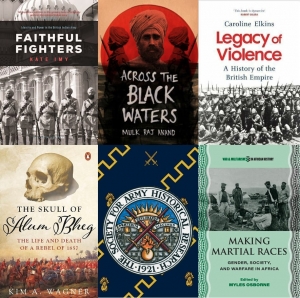
My list skews heavily toward colonial forces, especially the British Indian Army, but I hope that the books on here will offer interested readers an intriguing look into the British Empire at war.
First on my list is Kim Wagner’s The Skull of Alum Bheg: The Life and Death of a Rebel of 1857. It is no exaggeration to say that books about the 1857 Rebellion in India could fill a library, and, indeed, this isn’t even Wagner’s first book on the subject. (He previously published The Great Fear of 1857: Rumours, Conspiracies, and the Making of the Indian Uprising in 2010.) The Skull of Alum Bheg, though, is a rare entry that serves simultaneously as a useful entry point for readers seeking an introduction to the conflict and a new perspective on the rebellion for those already familiar with its contours. The book’s title refers to the remains of the unfortunate Alum Bheg, executed in 1858 for his putative—and, Wagner argues, scurrilous—role in the rebellion. After his execution, a British officer—Captain Costello—took his skull home to Ireland as a “curiosity,” where it would decorate a pub for generations. Wagner’s efforts to uncover the history of this grisly memento—an intellectual journey full of frustrations, disappointments, and epiphanies—forms the core of this fascinating book.
My second recommendation, Kate Imy’s Faithful Fighters: Identity and Power in the British Indian Army, takes up where Wagner leaves off. This brilliant book traces the development of the British Indian Army in the wake of the rebellions of 1857, exploring how the imperial state sought to understand the soldiers it recruited, revealing the increasingly complex bureaucratic apparatuses formed to police and to bolster its troops. Imy’s excellent chapter on the mobilization of Nepali Gurkhas in the First World War, for instance, examines the unwieldy logistics of shuttling returning troops to Dehradun for rituals meant to “purify” Gurkhas after their journey across the kala pani (“dark water” or open ocean). Officials assumed such ceremonies were essential to ensuring Gurkhas’ willingness to travel, requiring the trip even when troops complained that it was unnecessary or insufficient. As Imy shows, the debate about travel and “purity” in the broader Gurkha community had less to do with the kala pani itself than it did with conflict over Gurkhas’ relationship with the British Empire and its wars. The book brings the British Indian Army into focus as a site in which tensions between distinct identities—religious, ethnic, national, and imperial—played out.
Readers looking to round out their reading on the British Indian Army might be interested in Yasmin Saikia’s excellent The Raj at War, a thorough study of India in the Second World War. Saikia’s book, though, was already recommended on the SAHR list last year by Dr. Vipul Dutta. In the name of adding something “fresh” to the mix, let me look a bit further back in time to recommend Mulk Raj Anand’s classic novel Across the Black Waters, first published in 1937. It is the second and best-known volume of Anand’s trilogy exploring the life of Lalu, a Sikh peasant who enlists as a sepoy and fights in France during the First World War—earning it a not undeserved reputation as the Indian All Quiet on the Western Front. Like Anand’s other books, Across the Black Waters paints a rich portrait of life within the Raj, as Lalu and his fellow sepoys contend with the trauma of war and anxieties about their lives back home.
My fourth recommendation moves away from the Indian subcontinent to Africa. The armies that operated in Britain’s African colonies have attracted less attention from historians. Myles Osborne’s Making Martial Races: Gender, Society, and Warfare in Africa is an edited volume hot off the presses—published just this month by Ohio University Press—that seeks to address that gap. Osborne and his fellow contributors in this book also work to bring their research into conversation with broader imperial history. The book includes a conclusion by Heather Streets-Salter, whose 2004 book, Martial Races: The Military, Race, and Masculinity in British Imperial Culture, 1857-1914, brought forth a new understanding the way that military labor and ability was racialized in British India. This new volume positions Britain’s colonial armies in Africa as a part of this story, at once shaped by, contributing to, and at times challenging a broader imperial conception of martial aptitude. Though not all chapters are focused on British possessions, Osborne’s volume enriches our understanding of military service in the British Empire.
My final recommendation is a recent book that takes up the question of imperial warfare at a much more macroscopic level. The role that warfare, violence, and bloodshed played in an empire that often imagined itself as liberal, free, or commercial has been a subject of debate and, at times, discomfort at least since the time of Edward Seeley. Caroline Elkins’s Legacy of Violence: A History of the British Empire, published in 2022, offers an ambitious and capacious challenge to narratives that would marginalize military force within the story of empire. Following her previous, Pulitzer-Prize-winning analysis of the Mau Mau Rebellion (Imperial Reckoning, 2005), Elkins’s new book explores how violence—including both military and police action—undergirded the imperial state, even as it was rendered exceptional in official rhetoric. Focused mostly on the twentieth century, the book provides a strident and meticulously researched reevaluation of the empire as a whole.
Last, but not least, for anyone whose Christmas list needs a recommendation of a book to write, I’ve long been chagrined by the lack of books on the East India Company’s Bombay Army. Subordinate to the much larger Bengal Presidency and lacking the string of crises and conflicts that characterized the Company’s army in southerly Madras, Bombay has never loomed large in military histories of the Company—my own work very much included. A book that might bring its unique story into focus would enhance our understanding of colonial India as a whole.