


Annual Booklist 2023 : Dr Daniel Cowling
Daniel Cowling is a Historian at the National Army Museum in London. He completed his PhD at the University of Cambridge, where he wrote a thesis on the British occupation of Germany after the Second World War. He recently published his first book, Don’t Let’s Be Beastly to the Germans (Head of Zeus, 2023).
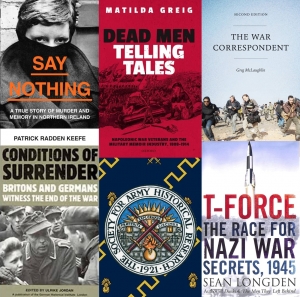
T-Force: The Race for Nazi War Secrets 1945 by Sean Longden
Sean Longden’s history is a very enjoyable account of the largely forgotten Anglo-American ‘Target Force’, a unit tasked with recovering German scientific and industrial technology at the end of the Second World War. Their ranks were filled with scientists, technicians, and even convicted safe crackers; efforts to secure secret documents, war materiel, and ‘human assets’ were no less varied. This is a truly remarkable story of kidnapping, dangerous liaisons, and daredevil efforts that stands out as one of the opening salvoes of the Cold War.
Conditions of Surrender: Britons and Germans Witness the End of the War by Ulrike Jordan
Ulrike Jordan’s study of Europe in 1945 is a rather unusual book, comprising both essays from a number of scholars as well as contemporary accounts from witnesses to history. These latter sources, ranging from media reports to the personal diaries of British soldiers, are chock-full of original political and personal perspectives on the final months of the Second World War.
Say Nothing: A True Story Of Murder and Memory In Northern Ireland by Patrick Radden Keefe
Twenty-five years on from the signing of the Good Friday Agreement we now have a growing literature on the history of the Troubles. A recent highlight is Say Nothing by Patrick Radden Keefe, a writer at the New Yorker who demonstrates a scholarly eye for detail in this gripping narrative. Say Nothing not only tells the story of a brutal murder but evokes a sense of the world in which it took place. While only touching upon the edges of the British Army’s role in Northern Ireland, this book is required reading for anyone hoping to comprehend the context for Operation Banner and the multifaceted character of this conflict.
Dead Men Telling Tales: Napoleonic War Veterans and the Military Memoir Industry, 1808-1914 by Matilda Greig
This is something of a departure from my own area of expertise but one that allows me to highlight a brilliant book by my colleague at the National Army Museum, Matilda Greig. Dead Men Telling Tales is an eminently readable and original take on the history of the Peninsular War. It challenges us to reconsider how histories are compiled, offers us rich insights into the personal lives of soldiers, and presents important conclusions on the afterlives of war stories relevant to those interested in all periods of military history.
The War Correspondent by Greg McLaughlin
The War Correspondent is probably the most comprehensive study of war reporting to date. It covers a wide range of conflicts, many of which have involved British forces. Beginning with Crimea, widely regarded as the first ‘media war’, McLaughlin narrates the history of war reporters and the changing character of their profession. As it reaches more contemporary conflicts, up to and including Russia’s 2014 invasion of Crimea, The War Correspondent features a number of insightful interviews with professional war reporters. Throughout it interrogates the complicated and, at times, tense relationship between the media and armed forces. This book is a vital complement to any serious study of war.
As to a book which doesn’t exist, but should, there is always the danger that one has overlooked an already-published tome. If this is the case then I can only apologise for my own ignorance (and do please let me know!). To the best of my knowledge, however, there has never been a comprehensive study of the influence of veteranhood upon British politics in the aftermath of the Second World War. From my own research into Britain’s occupation of Germany, it is noticeable how many MPs had military experience from one or both world wars. We know more about the generation of First World War veterans who were in power during appeasement and the wartime coalition. But I wonder if a collective biography of veterans in the cohort elected in 1945 (and beyond) might offer interesting insights into British political and military life in the second half of the twentieth century.